
Foodie Box
A food-prep meal kit service bringing your favourite restaurant's recipes straight to your doorstep.
Project Overview
Service & Product Design
University Project for ‘Innovation Design Studio’ USYD 2021
Context:
This case study outlines a 3-month project from my university coursework class called ‘Innovation Design Studio’ where I worked with two other design students to design a new service or product that would help ‘at risk’ industries severely impacted from the recent COVID-19 pandemic.
Limitations:
Although our team had limited time nor business experience, we had tutors to guide us and provide feedback along the way.
Contributions:
My primary role in our group was in ideation, iteration and data synthesis, however note I have since iterated upon the original prototype from mid to high-fidelity with additional designed features in order to showcase how I would further improve upon our initial proposal with my current design skills!
Problem Statement
The Challenge:
How can we bolster the economic stability of the struggling hospitality industry during these unprecedented times?
The Solution:
We devised a creative way for restaurants to generate income while helping customers spice up their weekly cooking routines: the Foodie Box meal kit subscription service.
UX Methods Used:
User Interviews, Affinity Diagramming, Thematic Analysis, User Personas, Brainstorming, Sketching, Storyboarding, Wireframing, Prototyping, Usability Testing.
Tools Used:
Pen & Paper, Recording App, Figma, Adobe Illustrator
Stage 1: Empathise
Exploring the Problem Space
In our first meeting, we brainstormed as a team to explore solutions to the given design brief for this class project, which was:
“Create an innovative design solution to support ‘at risk’ industries affected by the COVID-19 pandemic.”

Targeting a Niche
After our initial brainstorming sessions, we chose to design a new service/product that would bring more business to local restaurants during the pandemic.
How could we help restaurants reach more customers during times of limited dining capacity due to social distancing laws?
Our goal to help them was clear:
Create an alternative source of income for them while catering to our target customers who were looking to spice up their weekly cooking routines.
Asking the Right Questions
Our team prioritized getting deep personal insights on our customer base as soon as possible to consolidate our ideas in the early stages.
What we wanted to find out:
1. Why do users eat out at restaurants?
2. What's so special about visiting your favorite restaurant? What makes it different from eating at home?
3. What motivations and expectations would our potential customers have about ‘the dining experience’?
4. How could we replicate this experience at home?
Interviewing Potential Users
We began by diving into user research, conducting interviews about restaurant dining experiences. Although we only managed to interview six people due to time constraints, these deeply detailed conversations were invaluable to our design process. We also explored their cooking habits, skill levels, and motivations for dining out.
From our interviews alone, we observed 3 key Insights:
--> Dining out is seen as leisure and a social activity.
--> People seek new or authentic dishes.
--> Unique dining experiences and ambiance are highly valued
Stage 2: Define
Exploring our Data: Affinity Diagramming Method

Findings: User Needs
We used the affinity diagram method to further extract and consolidate our initial findings. Data is categorized by similar user needs from direct interview quotes. This method allows us to frame and draw insights from large amounts of primary data compiled from our interviews.
From analysing our interviews, we found out what user needs our service should prioritise: Saving money; Customizing meals; Challenging their cooking skills; Feeling a sense of accomplishment; Connecting with culture; Cost and convenience were crucial factors, as users often have limited time and prioritize budgeting.
Findings: Recurring themes
We categorized the found user needs into four themes:

User Personas
By analysing these themes and comparing them to user demographics we created user personas of our targeted audiences for Foodie Box.


Stage 3: Ideate
The ideation process involved brainstorming, sketching and storyboarding our ideas, then critically analysing and comparing each one to see if they fit our user needs and related strongly to the design brief.
Sketching

We then used sketching to achieve 3 things:
1. Roughly visualize how each of our ideas would work in reality.
2. Critique on whether or not they solve our users’ needs.
3. Consider if the idea would actually help the hospitality industry.
Our ideas included:
- A vending machine providing hot meals made by recipes from local partnered restaurants.
- A DIY cocktail drink making kits for bartending enthusiasts.
- A meal box kit service provided in collaboration with local restaurants for adventurous home cooks.
We had heated debates and spirited discussions, each of us advocating for our ideas. In the end, we settled on the restaurant meal box kit, seeing it as the most relevant and ethically viable option that catered to BOTH restaurants and customers.
Iterating on Initial Feedback
Our tutors and interviewees provided valuable feedback, helping us understand potential issues with our business idea.

Our initial idea included elaborate meal kits with multiple recipes, but feedback revealed hidden problems like high costs and logistical challenges, such as:
A. Tackling food waste, storage and packaging of food inside meal kits that maintains ethical sustainability practices.
B. Dealing with high packaging and delivery costs between warehouses and end users
C. Providing incentives for restaurants committing to partner with our service
D. Difficulties of authentically replicating the ‘full’ restaurant experience at home
This was a turning point. We had to rethink our approach. In the end, we focused on implementing sustainability and practicality.
We proposed partnering with local grocery stores for unused products and using recyclable packaging. This not only addressed sustainability but also reduced costs.
Iterative Features: Focusing on the 5 senses

To recreate the restaurant experience at home, we introduced features appealing to all five senses:
1. Smell/Taste/Touch:
High-quality ingredients to stimulate appetites:
- The aroma, taste and feel of the food and spices would be enough to stimulate their appetites while cooking.
- Making sure the ingredients are high quality is essential creating an enjoyable user experience.
2. Sound:
Music playlists from restaurants or specific cuisines
- A music playlist for each restaurant or cuisine, for example classic or jazz music for gourmet dishes, or music uploaded by the restaurant itself.
- This could be potentially linked to a Spotify playlist or be embedded with our website or application.
3. Sight:
Video tutorials for cooking techniques and social media sharing for finished dishes.
- Users can upload their finished dishes through social media or on the app to share with others or compile together as a “cooking story.”
- A video tutorial instead of reading the recipes on the food would allow users to freely use both hands and learn important cooking techniques from chefs to improve their own skills.
Storyboarding: Final Concept

Stage 4: Test & Iterate
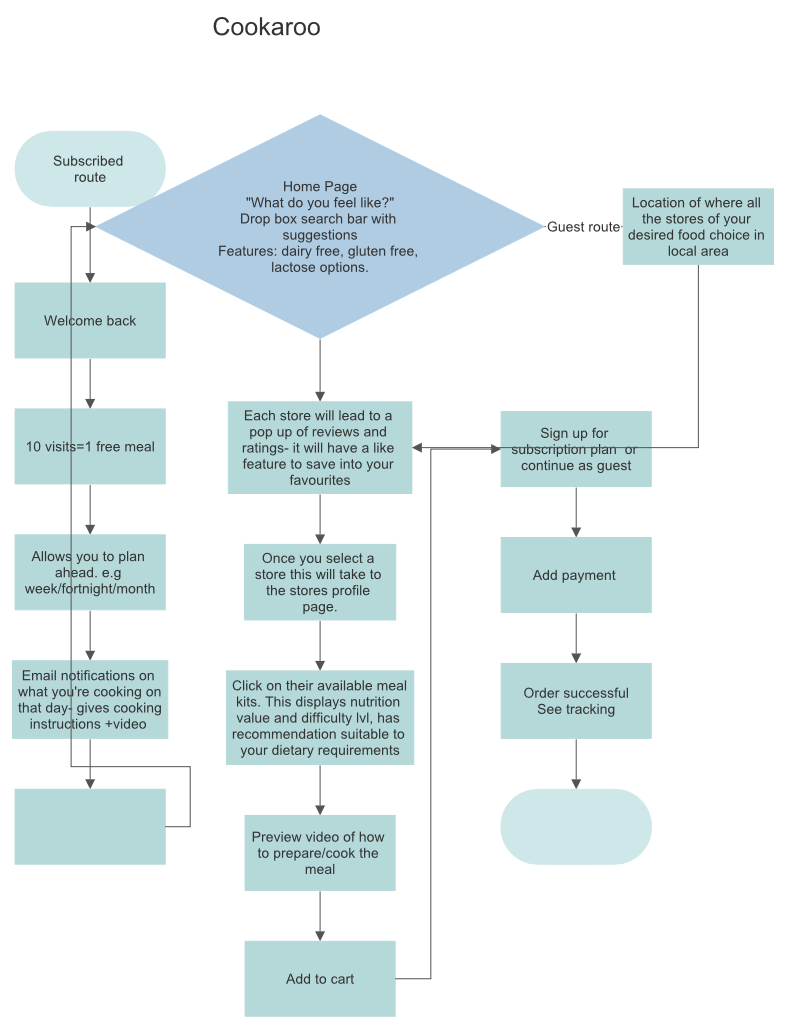
Having identified the purpose of our design, the high-level requirements and user needs, the team brainstormed features, pages and various elements of the prototype that we aimed to build.
Sitemap
Prototyping
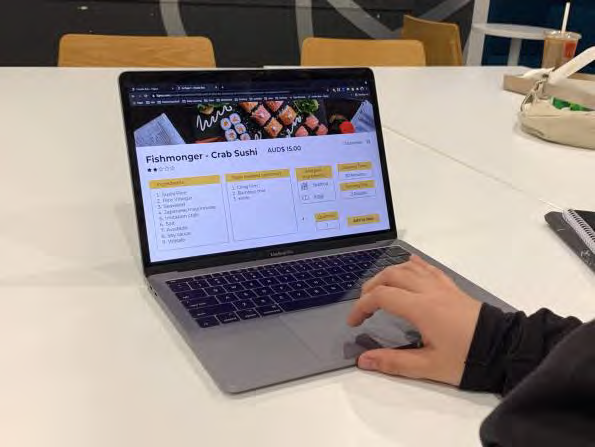
We developed mid-fidelity prototypes, creating a sitemap, landing page, and recipe search features.


Usability Testing
Usability testing involved walk-throughs with target users, who were prompted to complete tasks such as setting up accounts and searching for restaurants. Our step-by-step process was:
1. Select Testers: We chose 3-5 people from our target market.
2. Guide Through Application: Participants were given specific prompts to guide them through the application.
3. Assign Tasks: Tasks included setting up an account and searching for restaurants.
4. Assign Roles: Each team member had a role—one prompted the user, another recorded actions, and a third assisted with navigation.
5. Record Responses: Responses were documented in a table, noting if they could complete the tasks.
6. Analyze Feedback: We used the feedback to make improvements to the prototype.

Prototype Fidelity Challenges
Our first round of testing may have focused too much on aesthetics, which detracted from functionality. This feedback was disheartening, but we didn't let it stop us.
We regrouped and made a simple wireframe copy by taking out the color and images, to focus more on testing functionality.
After a second round of testing using just wireframes, we were eventually able to focus on the functionality features itself.
We then used feedback to iterate on our mid-fi prototype, again testing now on more aesthetic features after functionality had been established.
Stage 5: Deliver
Brand Colours & Logo
After coming up with the name, I used Adobe Illustrator to make logo design mockups for our new service.

Final Solution
Foodie Box offers an alternative income source for restaurants while providing customers with a way to replicate restaurant recipes at home.
“Foodie Box offers Australians to recreate local restaurant recipes through an immersive cooking experience.”
Our service promises a sensory dining experience, enhancing the cooking routine with high-quality ingredients, engaging music, and visual aids.
"The value we aim to provide goes beyond the means of a traditional application. It takes the form of a sensory restaurant experience for customers in the comfort of their own home."
Impact & Outcomes
At the start of this project, our design team of three aimed to find a new design opportunity that would help alleviate COVID-beaten industries at risk of shutting down.
We predict that our service idea ‘Foodie Box’ has a significant chance to positively impact ‘At Risk’ Hospitality (and more!) as it has the potential to:
-- Economically support struggling restaurants in disadvantaged situations.
-- Promote Local Businesses to new customers.
-- Provide affordable and quick tasty meals for busy people.
-- Provide high-quality alternatives to dining experiences without leaving home.Act as a new platform for restaurant-customer communities.
-- Teach lifelong cooking skills to those living alone or in isolation.
-- Expand a person's exposure to new foods and cuisines in an easy way.
-- Simplify the cooking process for more complex meals so new cooks do not get frustrated or intimidated by cooking skill gaps.
-- Make cooking accessible to more people, such as those with disabilities, rural areas or even children.
Concluding Thoughts
The Foodie Box project showcases the power of empathy, iterative design, and user-centered thinking in creating solutions that benefit both businesses and consumers during challenging times.